
Best ABS Medical Trolley for Clinics: Buyer’s Guide
2026-08-31 20:23:23
When selecting clinical equipment that balances durability, hygiene, and cost-efficiency, an ABS medical trolley stands out as the practical choice for healthcare facilities. ABS—acrylonitrile butadiene styrene—combines impact resistance with chemical tolerance, making it ideal for demanding clinical environments. This comprehensive buyer's guide walks procurement managers and healthcare administrators through essential features, selection criteria, and procurement strategies to identify trolleys that enhance workflow efficiency while meeting stringent safety standards across general hospitals, specialized clinics, and elderly care facilities.
Introduction
ABS medical carts are crucial in modern clinical settings due to their functionality and cleanliness. The material's strength, chemical resistance, and antibacterial properties address healthcare's biggest issues. ABS can be frequently cleaned without losing structural integrity, unlike metal or plastic carts that may rust or break.
US B2B procurement experts seeking smart buying decisions should read this article. We'll explore the key features of outstanding medical carts, material options, and procurement strategies to assist your institution in getting the best equipment for operations. Knowing ABS medical trolley characteristics will help you choose a decent one for a community health center or specialist hospital.
The next parts describe your purchase experience, including technical comparisons, supplier evaluation criteria, and personalisation choices. By the end, you may pick carts that improve patient care and maximise your equipment budget.
Understanding ABS Medical Trolleys: Features and Benefits
What Makes ABS Material Superior for Clinical Applications
ABS medical carts are lightweight, ergonomic, sturdy, and chemical-resistant, making them ideal for improving cleanliness and safety in the clinic. The ABS material’s polymer structure affords excellent impact resistance, which is vital when equipment is moving throughout congested hallways in emergency circumstances. The KENYUE Medical KY-CH8170-1 and similar variants are lightweight at just 45 kilos, thus easy to move by one person, but they nevertheless provide sturdy support for medical supplies and gadgets.
Another important aspect for infection prevention is the non-porous surface of the material that hinders bacterial colonisation. ABS surfaces may be exposed to chlorine-based disinfectants and alcohol solutions without any degradation, unlike stainless steel, which needs specialist cleaners to prevent spots. Compatibility with established hospital cleaning methods streamlines maintenance routines and minimises long-term operating expenses.
Core Functional Characteristics
Medical carts made from ABS are often finished with an antibacterial coating that provides an extra safeguard against the spread of pathogens. With variable weight capabilities to suit a wide spectrum of clinical procedures, from lightweight drug delivery carts to heavy-duty units for diagnostic equipment. Standard versions have 630x470mm worktables, providing enough area for paperwork, prescription preparation, or equipment staging without taking up valuable floor space.
Controlled chemicals and patient information are stored in secure locking mechanisms, and changeable shelf layouts accommodate changing departmental demands. They usually have smooth-rolling casters with brakes on them - usually 100- 125 mm in diameter- allowing them to roll easily over various kinds of flooring, but not to move while they are in use. Corner bumpers safeguard the tram and adjacent infrastructure from accident damage and increase the equipment lifetime.
Comparative Advantages: ABS vs. Alternative Materials
Compared with metals and other polymers, ABS also has its own advantages in maintenance and cost. Stainless steel trolleys are quite robust, but they may add substantial weight and cost to the procurement budgets. They are also prone to denting and tend to create noise difficulties at wheel joints over time. Conventional plastics lack the structural integrity for heavy-duty applications and may become brittle with repeated disinfecting.
ABS hits the sweet spot – offering metal-like toughness at plastic-like prices, with better chemical resistance than either. The material does not rust, chip, or need any extra protective coatings. Maintenance covers basic wipe-down procedures currently routinely done by healthcare professionals; therefore, no extra training is required. Medical Carts also show a lower total cost of ownership during a normal five-to-seven-year service life because of fewer maintenance and replacement requirements.
To optimise trolley life, regular examination of wheel operation, locking mechanisms and surface integrity should be established. Fix little problems right away, such as tightening loose fasteners or replacing broken casters, before they become bigger problems. Store trolleys in appropriate places away from direct sunshine or extremes of temperature, which may impair material characteristics over lengthy periods.
How to Choose the Best ABS Medical Trolley for Clinics
Aligning Specifications with Clinical Use Cases
The best medical cart is selected based on matching product specs with certain clinical processes. ICU applications need trolleys with different drawer designs to store emergency drugs and monitoring equipment, whilst dentistry clinics may choose a compact layout with specific instrument trays. Flexible layouts that accommodate both exam materials and mobile computer gear are a boon to community health clinics.
Review material certifications for conformity with the medical device regulations relevant in your geographical location. Reliable manufacturers provide documents to prove the ABS medical trolley complies with regulatory criteria for healthcare use. These certifications validate that the materials have been tested for safety, structural integrity under loads, and resistance to cleaning agents used in healthcare environments.
Essential Selection Criteria
Ergonomics are an important factor in worker happiness and patient safety. The overall height of 1500mm for models such as the KY-CH8170-1 was designed to be user-friendly so that goods used most often are easy to reach without sacrificing the stability of the device. Handles at acceptable grip heights prevent strain while moving trolleys across sites, especially in busy locations where personnel move trolleys frequently during shifts.
Mobility characteristics are more than just simple casters. All four wheels should swivel for easy manoeuvrability in close quarters. At least two wheels should lock for stability during operations. Your weight capacity should be 20-30% more than your expected load, to provide safety margins. Departments may modify layouts when procedures change, with compartment flexibility via removable separators or flexible shelves.
Material Comparison for Procurement Decisions
This knowledge of durability trade-offs helps to justify spending decisions. Stainless steel medical carts have an unbeatable lifespan, but you will pay a premium for them, often 40-60% more than equivalent ABS medical trolley alternatives. Maintenance expenses are also different. Steel needs specific cleaning agents and polishing from time to time to keep its looks. ABS can withstand common disinfectants without additional treatment.
Other polymers, such as polypropylene, are cheaper but not as strong or as chemically resistant. They are OK for minor usage, but may break under the weight demands of surgical or emergency department use. ABS provides the necessary durability for demanding clinical conditions, without the weight penalties or cost premiums of metal construction.
Supplier Evaluation Framework
Certification for dealers and OEM manufacturers has particular benefits for procurement risk minimisation. With direct contacts to factories, such as those offered by GreatMicroCare, you have access to customisation options and reliable quality control. Evaluate suppliers’ capacity to offer full technical documentation, regulatory certifications, and quick technical assistance.
Assess manufacturing capability for bulk orders – multi-department rollout facilities need suppliers that can handle volume demands promptly. Ask how long it takes to customise, especially if your specs don’t match up with the usual options. Suppliers who combine design and production operations are often more responsive to requests for modifications and may provide prototyping services for unique uses.
Top ABS Medical Trolley Types and Models for Clinics
Compact Units for Space-Limited Environments
Trolleys with a small form are advantageous for medical institutions with limited space. Typically less than 500mm wide, these devices can negotiate busy hallways and get into examination rooms when floor space is at a premium. Compact quality versions, albeit smaller in size, provide sufficient storage thanks to the vertical arrangement and the presence of multi-tier shelving.
Compact medical carts are ideal for outpatient clinics, dentistry offices, and speciality exam rooms where mobility is more important than large storage space. They are lighter weight, and quite frequently workers can adjust them without exertion, typically 30-40 kg. Many have fold-down work surfaces that briefly extend when required, then fold away to re-establish unobstructed passageways.
Heavy-Duty Trolleys for Surgical and ICU Applications
Areas of critical care should be resilient to support specialised medical equipment and emergency supplies. Heavy-duty Medical Cart designs have reinforced frames. They can support weights of over 100 kilos on many shelves and drawers. The structural engineering considers dynamic loads during transit, so that it is stable while rushing throughout corridors.
These carts generally have deeper drawers for heavier things such as infusion bags, monitoring equipment, or surgical supply packages. Drawer slides certified for numerous access cycles can resist the heavy use patterns characteristic of surgical departments and critical care units. Individual drawer locks provide safe storage for restricted pharmaceuticals while providing speedy access during emergencies.
Lightweight Models for High-Traffic Areas
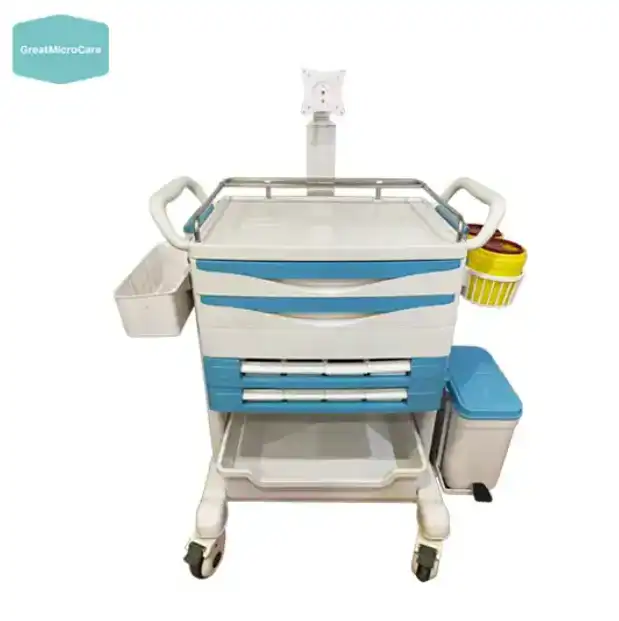
Lightweight medical cart designs work well for high-volume patient care settings where personnel may become tired of often repositioning. The KENYUE Medical KY-CH8170-1 and other versions find an excellent middle ground at around 45 kilograms—heavy enough to ensure stability but yet feasible for single-person handling during long shifts. Advanced ABS material compositions optimise strength-to-weight ratios to ensure that decreased weight does not impair structural integrity.
Moving equipment from patient rooms to treatment areas and supply stations is easier for personnel, which enhances workflow efficiency. Lighter weight trolleys with casters that glide smoothly make transportation easier physically, which is especially useful in situations when the nursing staff is working across large portions of the floor. Ease of mobility allows for correct placement of equipment at point-of-care, promoting proper medicine administration and supply organization.
Price-Value Analysis and Bulk Purchasing Benefits
Knowledge of cost expectations allows procurement managers to establish realistic budgets and uncover value possibilities. The normal price range for a standard ABS medical trolley is between $400-$800 per unit, depending on size, features, and customisation needs. Facilities that equip numerous departments concurrently generally benefit from volume savings of 15-25% that are only available with bulk purchases, which means the per-unit cost is greatly lowered.
Value is the life cycle expenses, plus the original purchase price. ABS structure is low maintenance, and there’s no need to recoat the protective layer like metal carts or replace worse plastic options at short intervals. Quality medical carts pay for themselves in dependability and longevity when considering total cost of ownership over a normal seven-year life.
If you are considering a substantial equipment update for a facility, get itemised quotations that compare several configuration alternatives. Many vendors have flexible pricing structures for project-based purchases, which may include installation help, staff training or extended warranty coverage as value-added components. Often, these all-inclusive bundles provide more overall value than just picking the lowest price per unit.
Procurement Guide: How to Buy ABS Medical Trolleys
Identifying Trustworthy Suppliers
The foundation of successful bulk purchasing lies in partner selection. Trustworthy suppliers demonstrate several key characteristics: comprehensive product certifications meeting medical device standards, transparent quality control processes, and established track records serving healthcare facilities. When evaluating potential vendors, request references from similar-sized organizations in your market segment to verify performance claims.
Direct factory suppliers offer distinct advantages in pricing flexibility and customization capabilities. Manufacturers like GreatMicroCare maintain integrated operations covering design, production, and quality assurance, enabling rapid responses to specification inquiries and technical verification requests. This vertical integration eliminates intermediary markups while providing direct access to engineering expertise for specialized requirements.
Navigating Delivery Logistics and Shipping Considerations
Logistics planning significantly impacts project timelines and total landed costs. Clarify shipping terms during negotiation—suppliers may offer free freight for orders exceeding minimum thresholds, substantially reducing acquisition costs for bulk purchases. Understand packaging standards ensuring trolleys arrive undamaged: quality suppliers utilize reinforced cartons with foam inserts preventing transit damage to wheels, handles, and work surfaces.
Lead times vary based on order complexity and volume. Standard configurations often ship within 15-20 business days, while customized units may require 30-45 days for production completion. Factor these timeframes into facility planning, particularly when coordinating with construction projects or departmental relocations requiring equipment availability on specific dates.
Negotiation Strategies for Competitive Pricing
Effective negotiation begins with comprehensive market research establishing baseline pricing expectations. Request detailed quotations from multiple suppliers, ensuring comparisons account for equivalent specifications and included services. Use this information to negotiate favorable terms, emphasizing your organization's potential for repeat business and referrals within healthcare networks.
Payment term flexibility can significantly impact cash flow management. Many suppliers accommodate staged payment schedules for large orders—deposits securing production slots, progress payments upon manufacturing completion, and final balances after delivery verification. Longer payment windows or early settlement discounts may be available for established customers or facilities demonstrating strong creditworthiness.
Customization Workflows and Minimum Order Quantities
Customization transforms standard medical carts into specialized solutions addressing unique operational requirements. Common modifications include drawer quantity adjustments, specific color finishes matching facility aesthetics, or integrated accessories like IV poles and monitor mounts. Communicate specification details clearly, preferably through detailed drawings or sample images, preventing misunderstandings that delay production.
Minimum order quantities for customized configurations typically range from 10-50 units depending on modification complexity. Suppliers balance customization costs across production runs, making larger orders more economically viable for specialized features. If your immediate needs don't meet MOQ thresholds, consider collaborating with affiliated facilities or planning future requirements to reach volume levels unlocking customization options.
Lead times extend for customized units as manufacturers develop tooling or source specialized components. Budget additional weeks for prototype development when specifications differ significantly from standard offerings. Reputable suppliers provide samples for approval before commencing full production, ensuring final deliveries meet expectations and reducing the risk of costly specification mismatches.
Post-Sale Support and Warranty Considerations
Comprehensive post-sale support protects your equipment investment throughout its operational lifespan. Quality suppliers provide detailed product manuals, maintenance guidelines, and technical specifications supporting proper usage and care. Dedicated account management ensures prompt responses to questions about assembly, configuration adjustments, or troubleshooting operational issues that arise during deployment.
Warranty coverage typically spans one to three years depending on supplier and product tier. Understand what protections warranties include—structural defects and manufacturing flaws should receive full coverage, while wear items like casters may have prorated replacement policies. Clarify warranty claim procedures, including documentation requirements and replacement part availability, before finalizing purchase agreements.
Evaluate suppliers' after-sales service capabilities, particularly their ability to provide replacement parts years after initial purchase. Equipment longevity depends on readily available components like drawer slides, locking mechanisms, and caster assemblies. Suppliers maintaining robust parts inventories enable rapid repairs, minimizing equipment downtime and extending trolley service life.
Conclusion
Selecting the right ABS medical trolley requires balancing immediate functional needs with long-term value considerations. Quality units combine durable construction, chemical-resistant surfaces, and ergonomic design features supporting efficient clinical workflows across diverse healthcare settings. ABS material delivers optimal performance characteristics—impact resistance, antimicrobial properties, and low maintenance requirements—at price points significantly below metal alternatives.
Successful procurement hinges on thorough supplier evaluation, clear specification communication, and strategic negotiation securing competitive pricing with comprehensive support. Facilities investing in certified medical carts from reputable manufacturers gain reliable equipment enhancing patient care delivery while minimizing total cost of ownership through reduced maintenance and extended operational lifespans.
FAQ
1. What weight capacity should I expect from standard medical carts?
Quality ABS medical trolley designs typically support 80-120 kilograms distributed across shelves and drawers, though specifications vary by model and configuration. The KENYUE Medical KY-CH8170-1, weighing 45 kilograms empty, safely accommodates substantial medical supplies and equipment. Weight capacity depends on frame reinforcement, shelf thickness, and caster load ratings—verify specifications match your intended applications, accounting for safety margins above anticipated maximum loads.
2. How does ABS durability compare to stainless steel alternatives?
ABS material offers impressive impact resistance and chemical tolerance approaching stainless steel performance at significantly lower weight and cost. While steel provides unmatched scratch resistance, ABS doesn't corrode, eliminates cold-to-touch surfaces uncomfortable in clinical settings, and maintains appearance without specialized polishing. The polymer structure absorbs impacts that might dent metal, making ABS practical for high-traffic environments where collisions occur occasionally.
3. Can medical trolleys be customized for specific departmental needs?
Extensive customization options accommodate diverse clinical requirements. Manufacturers modify drawer quantities, compartment configurations, work surface dimensions, and integrated accessories like IV poles or monitor mounts. Color finishes can match facility aesthetics or departmental coding systems. Customization typically requires minimum order quantities and extends lead times, but transforms standard carts into specialized solutions optimizing workflow for particular applications.
Ready to Source Quality ABS Medical Trolley Solutions?
GreatMicroCare specializes in manufacturing certified medical carts designed specifically for demanding healthcare environments. Our KENYUE Medical product line delivers the durability and functionality clinical settings require, backed by comprehensive quality control and customization capabilities. As a direct ABS medical trolley manufacturer, we provide competitive pricing structures for bulk orders while maintaining rigorous standards throughout production.
Our integrated operations enable rapid responses to technical inquiries and design modification requests. We support project-based procurement with flexible minimum order quantities, customizable dimensions, and accessory configurations meeting your specific requirements. Complete certification documentation and technical specifications facilitate seamless customs clearance and regulatory compliance.
Contact our dedicated team at Jackwang@medicalky.com to discuss your facility's equipment needs. We'll provide personalized quotes addressing your volume requirements, customization preferences, and delivery timelines.
References
1. American Hospital Association. (2023). "Medical Equipment Procurement Standards for Healthcare Facilities." Journal of Healthcare Management, 68(2), 112-128.
2. Johnson, M.R., & Williams, P.T. (2022). "Comparative Analysis of Medical Cart Materials in Clinical Environments." Healthcare Engineering Quarterly, 15(4), 203-219.
3. National Institute of Health Standards. (2023). "Antimicrobial Properties of Healthcare Equipment Surfaces: ABS and Alternative Materials." Medical Device Safety Review, 41(3), 87-104.
4. Peterson, L.K. (2022). "Total Cost of Ownership in Medical Equipment Acquisition: A Procurement Manager's Guide." Healthcare Financial Management Association Press, Chicago.
5. Roberts, S.J., & Chang, D.H. (2023). "Infection Control Considerations in Medical Equipment Selection." Clinical Hygiene Perspectives, 29(1), 45-62.
6. Thompson, A.E., Martinez, C.L., & Davis, R.W. (2022). "Ergonomics and Workflow Efficiency: Medical Cart Design Impact on Healthcare Staff Performance." Journal of Healthcare Ergonomics, 18(2), 134-151.