
Bedside Cabinet vs Nightstand: Which Fits Your Facility?
2026-09-12 15:38:09
Choosing a bedside cabinet over a standard nightstand in healthcare settings may greatly affect patient comfort, staff efficiency, and operational safety. Medical Bedside Cabinets include particular characteristics, including lockable storage, antibacterial surfaces, and mobility choices that are required for hospitals and eldercare institutions. While nightstands are attractive, they are not often durable or useful enough to be used in clinical settings. By understanding these variations, procurement professionals are able to make educated judgements that match budget limits with the demanding needs of healthcare environments, ultimately assuring the best possible delivery of patient care.

Understanding Bedside Cabinets and Nightstands
Defining Core Functions and Structural Differences
The difference between hospital bedside cabinets and home nightstands goes beyond just words. Medical bedside cabinets are multi-purpose workstations built for the hospital sector, where infection control, accessibility, and storage capacity are non-negotiable. Such units usually include many sections that include locked drawers for the safe storage of medications and movable shelves to accommodate medical equipment of different sizes.
Nightstands, by contrast, emphasise aesthetic value and simple storage of personal goods. These are frequently only a tabletop and have either one or two drawers, which makes them perfect for storing books, lamps, or alarm clocks in a home or hospitality situation. Medical equipment, however, is seldom intended for storage on nightstands, and nightstands are not often designed to endure the rigors of repeated sanitisation.
Material Selection for Healthcare Environments
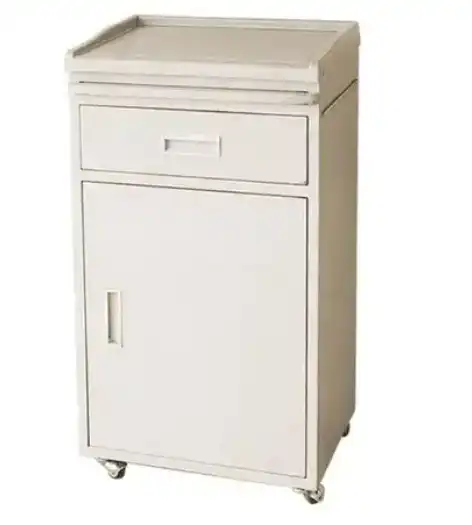
GreatMicroCare produces bedside cabinets using medical-grade materials that conform to demanding healthcare regulations. The KY-KH8943-1 product is built from steel spray and measures 440×460×790mm, making it durable for tough clinical settings. The stainless steel structure is resistant to corrosion from chemical disinfectants, and the ABS tabletops are resistant to chemical damage, which facilities need to maintain stringent hygiene practices.
Traditional nightstands are made out of wood, particleboard, or ornamental laminates that cannot stand up to repeated applications of medical-grade cleaning solutions. These materials may either harbour germs on porous surfaces or break down when sanitised frequently. The only possible solution is the use of specialised medical cabinets. Medical institutions need furniture made of non-porous materials with smooth surfaces that do not allow microbial colonisation.
Standard Dimensions and Space Planning
Medical bedside cabinets are generally 440- 500 mm wide, 400- 460 mm deep, and 790- 800 mm high. These proportions allow the patient to easily reach inside the cabinet without disturbing the personnel. The dimensions are compatible with conventional hospital beds and allow for storing the patient’s possessions and medical supplies.
Most residential nightstands are rather varied; generally, they are around 18-24 inches (460- 610 mm) broad and tend to be designed for aesthetic proportion more than practical capacity. This variation poses procurement problems for establishments that need standardised equipment for various rooms. Medical-grade cabinets are dimensionally consistent, which makes it much easier to design space and buy in bulk.
Specialized Adaptations for Clinical Settings
Healthcare bedside cabinets include features not seen on regular nightstands, such as locked drawers for prohibited drugs, integrated power outlets for medical instruments, and optional IV pole attachments. The design is patient-safe and has rounded edges, solid bases to avoid tipping, and antimicrobial coatings to help limit the risk of transfer of infections.
The Medical Nightstand versions include swivel wheels that are fitted with locking mechanisms to allow personnel to move the units during room cleaning or in emergency scenarios, but to keep them stable during routine usage. These mobility capabilities play a vital role in contexts where flexibility and efficiency may directly affect patient outcomes and staff workflow optimisation.
Comparing Features: Bedside Cabinet vs Nightstand
Storage Capacity and Security Features
The storage architecture of medical bedside cabinets addresses specific clinical requirements that nightstands cannot fulfill. Lockable drawers secure medications, patient valuables, and sensitive medical records, complying with HIPAA regulations and controlled substance protocols. Adjustable shelving accommodates varying equipment sizes, from IV bags to monitoring devices, maximizing vertical storage efficiency.
Nightstands typically offer open shelving or shallow drawers suitable only for personal items like eyeglasses or reading materials. The absence of locking mechanisms creates security vulnerabilities inappropriate for healthcare environments where medication safety and patient privacy are paramount concerns.
Mobility and Accessibility Considerations
Medical bedside cabinets feature engineered mobility systems that balance easy movement with secure positioning. Our swivel casters enable effortless relocation by a single staff member, reducing physical strain during room turnovers or patient transfers. Locking mechanisms engage instantly to prevent unintended movement during patient interaction or equipment use.
Standard nightstands remain stationary, often lacking any mobility features. This immobility complicates cleaning protocols and limits spatial flexibility—critical disadvantages in healthcare settings where efficient room utilization and infection control depend on furniture adaptability.
Durability and Material Performance
Healthcare environments subject furniture to conditions that quickly degrade residential-quality pieces. Our bedside cabinets undergo rigorous quality control testing to ensure resistance to impacts, chemical exposure, and continuous use. The stainless steel frames maintain structural integrity even after years of service, while ABS surfaces resist scratching, staining, and chemical degradation.
Wooden nightstands deteriorate when exposed to moisture and cleaning chemicals, developing warping, finish damage, or joint separation. The replacement cycle for residential furniture in clinical settings significantly increases long-term costs, making initial investment in purpose-built medical cabinets more economical over equipment lifecycles.
Ergonomic Design and Safety Standards
Medical bedside cabinet design incorporates ergonomic principles that support both patient independence and caregiver efficiency. Strategic drawer placement enables patients to access personal items without excessive reaching or twisting. Tabletop heights align with bed surfaces, creating accessible workspaces for meal service or medication administration.
Safety features include rounded corners that minimize injury risks, anti-tip designs that prevent toppling during drawer use, and smooth-glide mechanisms that reduce pinch hazards. These considerations reflect compliance with medical equipment safety standards rarely applicable to residential nightstand manufacturing.
How to Choose the Right Bedside Cabinet or Nightstand for Your Facility
Assessing Facility-Specific Requirements
Procurement of healthcare should be in accordance with the kind of institution and the nature of the patient population. General hospitals need cabinets that can adapt to a range of medical equipment, while specialised institutions may need custom-configured cabinets. Lower cabinet heights, as well as added stability elements to assist with age-related movement constraints, are helping to serve elderly care facilities.
Community health clinics sometimes try to make a clinical space seem like a home and may cover industrial stainless steel with wood-grain finishes. We are able to make dimensional alterations, modify accessories, and pick materials that satisfy specified technical requirements while keeping medical-grade performance standards.
Material Selection and Maintenance Requirements
The choice of materials should also include the materials’ suitability for cleaning, durability, and cost. Initial prices are greater, but stainless steel and ABS construction give better lifespan and infection control advantages. These materials are resistant to surface deterioration with daily disinfection with quaternary ammonium compounds, bleach solutions, or vaporised hydrogen peroxide.
Facilities should be looking at the entire cost of ownership and not just the purchase price. Medical-grade cabinets could cost 40-60% more initially, but with an average lifespan of 10-15 years compared to 3-5 years for residential-grade counterparts, annualised expenses are lower and replacement disruption is decreased.
Security Features and Compliance Standards
Healthcare institutions have rules they must follow on how to store medicine, keep patient information private, and keep equipment secure. Lockable compartments in Medical Nightstands comply with Drug Enforcement Administration storage regulations for restricted substances. Drawer locks not only reduce liability risk and improve patient happiness but also provide a measure of protection for patient items.
When assessing vendors, ensure that items are accompanied by required certificates that prove compliance with medical equipment requirements. GreatMicroCare offers comprehensive certification papers and technical standards for regulatory approval and customs clearance for foreign shipping.
Budget Optimization and Procurement Strategies
Bulk purchase dramatically decreases per-unit costs and allows standardisation of equipment across plants. We sell directly from the manufacturer, so there are no middlemen markups. We can provide very low prices and never sacrifice quality. Each project order is assigned to a professional account manager who coordinates production schedules and delivery dates.
Assess vendors on warranty terms, after-sales service, and their capacity to customise products or services if needed. Comprehensive service agreements should include items such as confirmation of technical specifications, openness of order tracking, and prompt resolution of quality complaints. These criteria reduce procurement risks and safeguard the long-term value of investments.
Top Industry Brands and Procurement Channels for Bedside Cabinets
Comparing Manufacturer Offerings
Consumer companies like IKEA, Wayfair, and Sauder dominate the home furniture industry, but their goods are not specified for medical uses. Healthcare providers require producers of medical-grade equipment with a history of regulatory compliance and expertise in the clinical setting.
GreatMicroCare is a manufacturer of medical furniture with extensive experience serving the needs of the healthcare industry. We are ISO certified and use quality control techniques in our manufacturing facilities to make sure that every bedside cabinet satisfies performance criteria that are essential to patient safety and regulatory compliance. This specialisation gives a degree of dependability that is not available from typical furniture vendors.
Direct Factory Advantages vs Distribution Channels
There are major advantages in direct factory procurement over third-party distribution. Direct sourcing removes markup layers, cutting costs by 20-35% vs. distributor price. Most importantly, communicating directly with manufacturers allows you to discuss customisation, technical verification, and quick design changes that you cannot get when buying via middlemen.
We blend design, manufacturing, and sales to work together to provide solutions for the specific needs of a facility. Be it changes in cabinet sizes to suit certain room configurations or adding unique attachments for certain medical equipment, dealing directly with the manufacturer helps achieve procurement results that are exactly aligned with operational requirements.
Delivery, Installation, and After-Sales Support
Unlike commodity furniture dealers, professional medical equipment providers offer a complete solution, including delivery, assembly, and continuing support. We synchronise our steady production schedule with facility timeframes to ensure that equipment is available when the refurbishment is complete or the expansion is opened.
Robust packing protects cabinets during overseas shipments, minimising transportation damage that causes installation delays and adds expenses. We offer full technical documentation, assembly instructions, and maintenance recommendations to help facility personnel with correct equipment care. Account managers are committed and react quickly to specification queries, order status enquiries, and after-sales support requirements.
Evaluating Total Value Beyond Purchase Price
Smart procurement takes a comprehensive view of suppliers rather than just picking them on the basis of the lowest offer price. If you compare possibilities, look at the warranty period, the availability of spare parts, and the speed of technical assistance. Even if the upfront cost is greater, the total value over time is better if you buy a full-service package from a supplier.
We have a lot of expertise in medical exports and know the needs of the South American, North American, and world markets. This know-how leads to effective communication, accurate customs clearance documents, and compliance with regional medical equipment standards, which streamlines procurement and reduces administrative strain on facility personnel.
Maintenance and Safety Tips for Bedside Cabinets and Nightstands
Cleaning Protocols for Medical Environments
Proper choice of cleaning agents appropriate for cabinet materials is the keystone of effective maintenance. Stainless steel surfaces are resistant to harsh disinfectants, including bleach solutions up to 10% concentration, and ABS components are resistant to harm from quaternary ammonium compounds and alcohol-based sanitisers. Surface contamination is removed during daily cleaning, while the drawer inside and hardware are carefully cleaned weekly.
Avoid harsh cleaning pads that may destroy protective coatings and create surface imperfections for germs to colonise. The integrity of the surface is maintained, while efficient disinfection is provided using microfibre cloths with suitable cleaning solutions. See manufacturer for chemical compatibility. Premature material deterioration, which might impact the cabinet's look and performance.
Preventing Tipping Hazards and Injury Risks
Cabinet stability means being aware of weight distribution and properly locking the casters. Make sure the wheels are locked before patients utilise the cabinet surface to support themselves while moving about. Put heavy stuff in the bottom drawers. Keeps the center of gravity low and less likely to topple over when you open the top drawers.
Train personnel on proper loading methods, not to overload drawers beyond weight capacity standards. All of our cabinets have anti-tip designs, but good practices add to the margin of safety. Regularly examine casters, drawer slides, and locks for proper operation and repair any wear immediately to preserve them in excellent working order.
Routine Inspection and Preventive Maintenance
Scheduled maintenance programs prolong the life of equipment and identify probable faults prior to the time they disrupt operations. Monthly checks should include checking that the casters roll and lock, that the drawers are aligned and operate smoothly, and that hardware is tight. Fix little problems as they occur, or they may compound into something needing a lot of work to fix.
Annual thorough examinations include structural integrity, surface condition, and general functioning. - Document inspection results and maintenance performed, which provide a service history that may be helpful in accreditation review and verifying adherence to equipment management requirements. By doing preventive maintenance, you may avoid unscheduled downtime and increase return on investment.
Compliance with Safety Standards and Regulations
Health care furniture must meet criteria for fire safety, electrical safety, and infection control. Verify that the cabinets have the required certificates indicating compliance with the rules in your area. Flame spread rates, smoke development indices, and VOC emission statistics should be included in material specifications.
We have compliance verification at various stages of the manufacturing process, and the completed goods comply with international standards for medical equipment. Shipments are accompanied by full certification paperwork to facilitate facility accreditation and regulatory inspections, eliminating the need for further testing or verification.
Conclusion
When choosing Bedside Cabinets and nightstands for healthcare institutions, clinical utility trumps residential aesthetics in the end. Nightstands don't have the attributes of medical-grade bedside cabinets: safe storage, antibacterial materials, mobility, and durability. While the initial investment surpasses the prices for home furniture, the price discrepancy is justified by increased lifespan and operational advantages. Facility managers should consider total cost of ownership, regulatory compliance, and patient safety when making purchasing choices. Partnering with dedicated manufacturers provides access to solutions designed to satisfy the needs of the healthcare industry and improves budget efficiency via direct sourcing agreements.
FAQ
1. What distinguishes medical bedside cabinets from residential nightstands?
Medical bedside cabinets incorporate specialized features essential for healthcare environments: lockable storage for medications, antimicrobial materials preventing infection transmission, mobility systems enabling easy repositioning, and durable construction withstanding frequent disinfection. Residential nightstands lack these clinical specifications, focusing instead on decorative appeal and basic storage unsuitable for medical applications.
2. How do I determine appropriate bedside cabinet dimensions for my facility?
Standard medical bedside cabinets measure 440- 500 mm wide, 400- 460 mm deep, and 790- 800 mm tall, optimized for patient accessibility and staff workflow. Measure available floor space adjacent to beds, ensuring cabinets fit without obstructing movement paths. Consider ceiling-mounted equipment, door swing clearances, and emergency access requirements when finalizing dimensional specifications for your facility.
3. What materials best suit healthcare bedside cabinet applications?
Stainless steel frames and ABS surfaces offer optimal performance in clinical settings, providing corrosion resistance, chemical compatibility with disinfectants, and non-porous surfaces preventing microbial colonization. These materials withstand rigorous cleaning protocols while maintaining structural integrity and appearance throughout extended service life, making them superior to wood or composite alternatives.
procurement decisions. Partnering with specialized manufacturers ensures access to purpose-built solutions meeting healthcare sector demands while optimizing budget efficiency through direct sourcing relationships.
Partner with GreatMicroCare for Your Medical Bedside Cabinet Needs
GreatMicroCare operates as a specialized bedside cabinet manufacturer offering comprehensive solutions for healthcare facilities worldwide. Our direct factory supply model delivers exceptional value through competitive pricing, rigorous quality control, and extensive customization capabilities addressing unique facility requirements. We support bulk orders and project-based procurement with dedicated account management, ensuring seamless communication throughout the purchasing process.
Our product line carries full medical certifications, facilitating market access across international regions, with complete technical documentation and customs paperwork streamlining import procedures. Whether your facility requires standard configurations or customized dimensions, materials, and accessories, our integrated design and production capabilities enable rapid prototyping and technical verification. Contact our team at Jackwang@medicalky.com to discuss your Bedside Cabinet requirements and discover how our one-stop solutions minimize procurement risks while optimizing operational outcomes.
References
1. American Hospital Association. Standards for Hospital Furniture: Safety and Durability Requirements in Clinical Settings. Journal of Healthcare Facilities Management, 2022.
2. Centers for Disease Control and Prevention. Guidelines for Environmental Infection Control in Healthcare Facilities. Healthcare Infection Control Practices Advisory Committee, 2021.
3. Facility Guidelines Institute. Guidelines for Design and Construction of Hospitals. 2022 Edition.
4. International Organization for Standardization. ISO 14971: Medical Devices - Application of Risk Management to Medical Devices. 2019.
5. National Fire Protection Association. NFPA 101: Life Safety Code for Healthcare Occupancies. 2021 Edition.
6. Ulrich, Roger S., et al. The Role of the Physical Environment in the Hospital of the 21st Century: A Once-in-a-Lifetime Opportunity. Center for Health Design, 2020.